

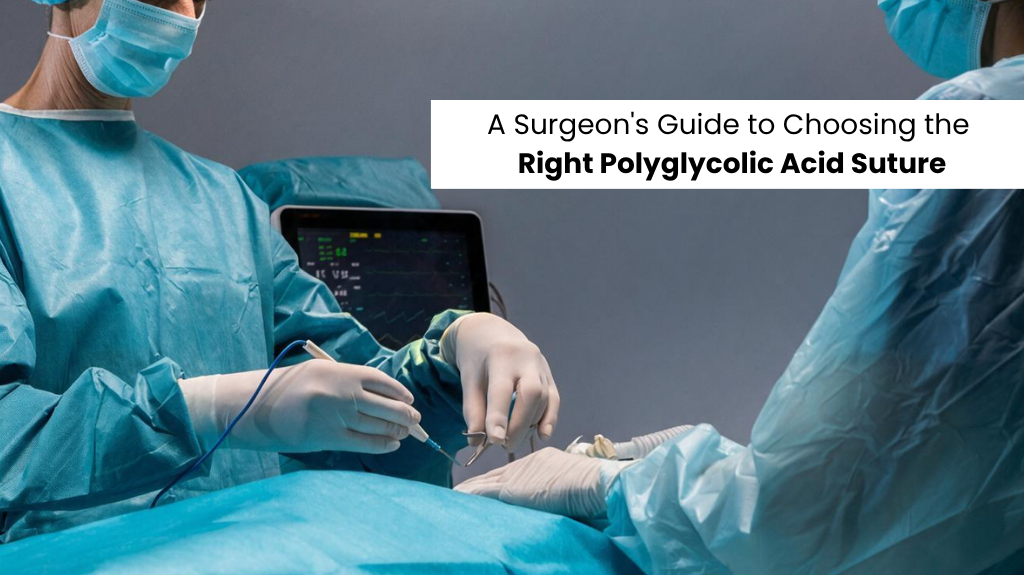
A polyglycolic acid suture is a synthetic, braided, absorbable suture that dissolves in the body through hydrolysis, typically supporting a wound for around four weeks before breaking down completely. If you’ve ever picked one up mid-case and wondered whether it would hold long enough for the tissue in front of you, that single fact usually answers the question. Except for that, the handling, the knot behaviour, and the exact timeline are details worth knowing before the next case, not during it.
What Is Polyglycolic Acid Suture Material, Really?
Ask a resident to define it, and you’ll usually get the green one that dissolves. Fair enough, but there’s more going on. Polyglycolic acid suture material is a synthetic polyester, spun into fine filaments and braided together to form a suture strand, then coated for smoother passage through tissue. That braiding is what gives it a soft, pliable feel in the hand and a knot that sits down securely without slipping.
This isn’t new chemistry. Polyglycolic acid was the material behind the first synthetic absorbable suture ever developed, replacing catgut as the standard braided absorbable option decades ago, and it’s stayed relevant because the fundamentals haven’t been improved on so much as refined. Predictable strength, predictable breakdown, minimal tissue reaction. That combination is hard to argue with.
Is a Polyglycolic Acid Suture Absorbable? Here’s What Happens After Closure
Yes, and the way it disappears is worth understanding rather than taking on faith. Once placed, a polyglycolic acid suture is absorbed through hydrolysis, meaning water gradually breaks down the polymer chain rather than the body actively digesting it the way it would with catgut. That process is slow and even, which is exactly why the suture holds tensile strength through the critical healing window instead of losing integrity unpredictably.
For most polyglycolic acid suture options, tensile strength holds through the first few weeks, then tapers off to around 25% by day 28. That’s by design, not failure. It’s exactly the window where the wound needs the most mechanical help, and the suture is built to give up its strength on that schedule rather than all at once. Complete absorption then follows between day 60 and day 90. After that, nothing is left behind to explain to a patient at a follow-up visit, and nothing sits in tissue long-term for the body to react to.
Polyglycolic Acid Suture Uses You’ll Actually Run Into
The honest answer to what it is good for is: most soft tissue approximation where you want a secure, absorbable, braided option. In practice, polyglycolic acid suture uses tend to cluster around:
1. Soft tissue approximation across general, gynaecological, and obstetric procedures, where a braided suture’s handling and knot security matter more than a smooth glide
2. GI and abdominal closures, where predictable absorption within a few weeks lines up well with how quickly that tissue typically regains strength
3. Plastic and oral surgery, where a suture that disappears on its own spares the patient a removal visit for closures that don’t need permanent support
4. Any closure where knot placement under tension is a concern, since the braided structure resists slipping better than most monofilament alternatives
What it isn’t built for is long-term or high-tension load-bearing closures, cardiovascular work, or anywhere you need the suture to be still doing its job well past the six-week mark. That’s a job for a slower-absorbing or non-absorbable material instead.
Aqmen’s Polyglycolic Acid Suture, Built the Same Way Every Time
Aqmen Medtech manufactures a Polyglycolic Acid suture as a braided and coated synthetic absorbable option, engineered for soft tissue approximation with roughly 28 days of wound support. A few things stand out on the table:
1. Excellent knot security and knot placement, so the braid holds where you set it instead of creeping under tension
2. Predictable absorption and wound support profile, batch after batch, because every suture runs through checks at the pre-production, production, and post-production stages before it leaves the facility
3. High tensile strength, giving you margin through the period where the wound is doing the most work to hold itself closed
If you’ve dealt with inconsistent knot behaviour or absorption that doesn’t match the label from a different supplier, that’s precisely the variability this level of process control is meant to remove.
When Infection Risk Changes the Choice
Not every closure has the same risk profile, and that’s why it’s worth knowing what else sits next to the polyglycolic acid suture on Aqmen’s shelf. For contaminated fields or patients at higher risk of infection, some absorbable sutures come with an antibacterial coating built in. Aqmen’s Polysolve+™ takes the same braided, coated base and adds triclosan, an antibacterial agent shown to reduce bacterial colonisation on the suture surface during the early healing window.
It’s not a swap for good surgical technique, and it’s not needed on every case. But when you’re closing a wound where contamination is a real concern, having an antibacterial, triclosan-coated absorbable suture in the same tray as your standard polyglycolic acid suture means you’re choosing based on the case in front of you rather than settling for whatever’s on hand.
Polyglycolic Acid vs. Polyglactin 910: A Question Worth Settling
Surgeons ask this often enough that it deserves a straight answer. Both are synthetic, braided, coated, and absorbable, and both sit in the same general family of wound support, so it’s easy to assume they’re interchangeable. They’re not identical materials, but they’re close cousins built to solve the same problem. If your case calls for a braided absorbable suture with dependable knot security and a roughly month-long support window, either fits the brief, and the choice usually comes down to what your team is already comfortable handling and what’s consistently available from your supplier. Browse Aqmen’s full range of absorbable sutures to compare the options side by side.
Frequently Asked Questions
A polyglycolic acid suture is used mainly for soft tissue approximation in general, gynaecological, obstetric, plastic, and GI surgery, wherever a braided absorbable suture with strong knot security is needed for a few weeks of wound support.
Yes, a polyglycolic acid suture is absorbable. It breaks down through hydrolysis over roughly 28 days, providing steady wound support through the healing window before being fully absorbed by the body.
Most polyglycolic acid suture options provide around 28 days of wound support before the material gets fully absorbed gradually, and lines up with the period that most soft tissues need to regain their own strength.
Common polyglycolic acid suture uses include soft tissue approximation, abdominal and GI closures, and general, gynaecological, obstetric, and plastic surgery, anywhere a secure braided absorbable suture is preferred over a monofilament option.
Yes. Alongside its standard polyglycolic acid suture, Aqmen manufactures Polysolve+™, a 910 antimicrobial coating that gives surgeons a braided, absorbable option for contaminated or higher-risk fields without changing the handling they’re used to.