

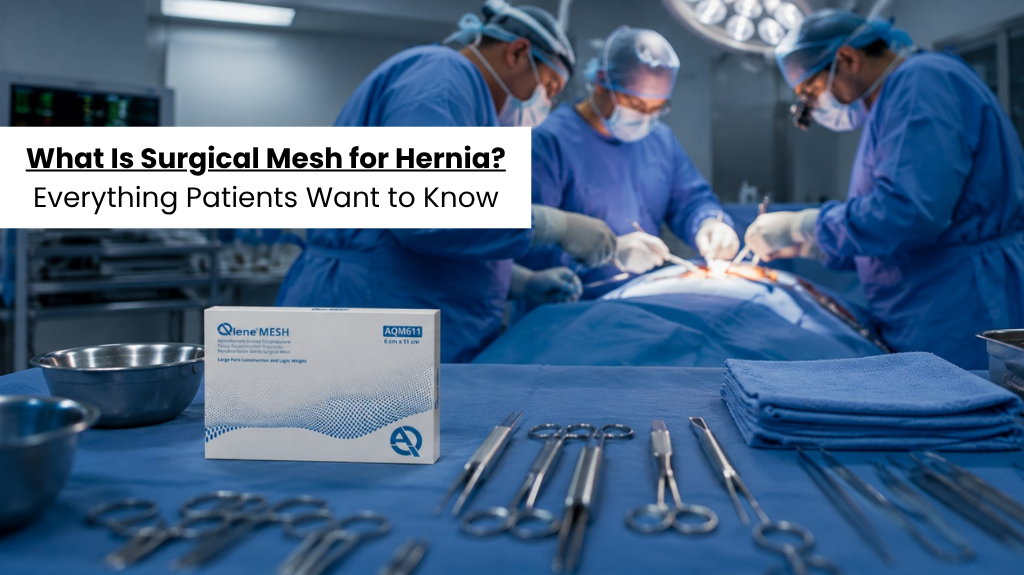
Surgical mesh for hernia is a thin, flexible medical implant that surgeons place over a weak spot in your abdominal wall to hold it together while your own tissue heals around it. Think of it as scaffolding for a wall that’s lost its structural support. If your doctor has just told you that “mesh repair” is the recommended route, you’re probably left with more questions than answers. Fair enough. It’s your body, and you deserve to understand what’s going on in it before you sign that consent form.
Let’s walk through this the way we’d want a doctor friend to explain it over chai, not the way a textbook would.
Understanding Hernia Pathophysiology and the Clinical Rationale for Mesh Reinforcement
A hernia happens when an organ or tissue pushes through a weak point in the muscle wall that’s supposed to hold it in place, most commonly around the groin, navel, or a previous surgical scar. You might have noticed a bulge that gets more obvious when you cough, lift something heavy, or stand for too long. That’s your body quite literally showing you where the wall gave way.
Stitching the edges of that weak spot back together (called primary closure) works for very small hernias. But for most adult hernias, the tissue around the defect is often too thin or too stretched to hold sutures alone under everyday strain, walking, lifting, laughing, sneezing. That’s exactly where hernia repair with mesh comes in: instead of pulling weak edges together under tension, the mesh sits over or behind the defect and distributes that everyday strain evenly, which is a big part of why mesh repairs have significantly lower recurrence rates than suture-only repairs. Getting this right in the operating room also comes down to proper hernia kit use, the mesh, fixation devices, and instruments all matched correctly to your specific case.
What Is Mesh Used in Hernia Repair Actually Made Of?
This is where most patients get surprised, there isn’t just one kind of mesh, and the material matters.
-
Polypropylene surgical mesh:
The most widely used option globally. It’s a synthetic, non-absorbable material, meaning it stays in place permanently and becomes woven into your own tissue over time. It’s valued for its strength, flexibility, and long clinical track record.
-
Composite mesh:
Used when part of the mesh will sit close to internal organs (common in ventral or incisional hernias). One side is designed to encourage tissue growth, the other side has a smoother barrier layer to prevent the mesh from sticking to the bowel.
-
Dual mesh:
Arelated two-layer design, often built with a polymer barrier, again used specifically for intra-abdominal placement where organ contact is a real consideration.
-
Absorbable mesh:
Dissolves gradually as your own tissue takes over the support role, used in specific cases like contaminated or infected surgical fields where a permanent implant isn’t advisable for a surgical mesh for hernia procedure.
Your surgeon picks the type based on where your hernia is, how it’s being repaired (open, laparoscopic, or robotic), and your own health history, not a one-size-fits-all decision.
Does Hernia Mesh Size Actually Matter?
Yes, more than people expect. Hernia mesh size is chosen to comfortably overlap the defect on all sides; surgeons generally aim for several centimetres of healthy tissue overlap beyond the edges of the hernia itself. Too small, and the repair is under more tension and more likely to fail. Too large or ill-fitting for the space, and it can bunch, fold, or cause discomfort. This is one of several reasons the actual hernia kit use in the operating room, the full set of the correctly sized mesh, fixation devices, and instruments matched to your specific case, matters as much as the surgeon’s technique.
Is Surgical Mesh for Hernia Safe?
This is usually the real question underneath all the others, so let’s not dance around it. Like any implant, mesh isn’t risk-free, infection, chronic discomfort, or, rarely, mesh-related complications requiring further treatment can occur. But for the vast majority of patients, hernia mesh significantly reduces the chance of the hernia coming back compared to non-mesh repair, and most people return to normal activity within a few weeks.
What actually moves the needle on safety isn’t just “mesh vs. no mesh” it’s mesh quality, correct sizing, and surgical technique together. This is precisely why the manufacturing side of surgical mesh, whether it’s polypropylene surgical mesh or another material, consistent pore structure, tensile strength checked at every production stage, along with biocompatibility testing on the finished product, is something worth asking your hospital or surgeon about, the same way you’d ask about the make of any device going inside your body.
Questions Worth Asking Your Surgeon Before the Surgical Mesh for Hernia Procedure
1. Which type of mesh are you using, polypropylene, composite, or dual mesh, and why is it the right fit for my hernia?
2. Is it a permanent (non-absorbable) or absorbable mesh?
3. What size and overlap are you planning, and does that match standard guidance for my hernia type?
4. What’s your experience with this specific mesh and technique?
5. What does recovery typically look like for someone in my situation?
Asking these isn’t being difficult, it’s being an informed patient, which every good surgeon will respect.
The Bigger Picture
Surgical mesh for hernia has come a long way since it was first introduced in surgery over a century ago, evolving through generations of material science to become one of the most extensively studied implants in general surgery today. For hospitals and surgeons, that evolution has meant access to meshes engineered specifically for high tensile strength and long-term biocompatibility, the qualities that actually translate into fewer recurrences and better patient outcomes in the operating room.
If you’re a surgeon or procurement team evaluating mesh options, Aqmen Medtech’s surgical mesh range is engineered for exactly this, consistent quality, reliable tensile strength, and dependable performance repair after repair. Explore the full product range or get in touch with our team to discuss which mesh fits your surgical requirements.
Frequently Asked Questions
What is the hardest day after hernia mesh surgery?
Most patients find days two and three the toughest, as initial swelling peaks and the anaesthesia wears off completely. Discomfort around the hernia mesh site is normal at this stage and typically eases steadily from day four onward, with most people back to light activity within a week or two.
Is surgical mesh for hernia really bad, or is that just a myth?
No, surgical mesh for hernia is one of the most extensively studied implants in general surgery, and complication rates are low for the vast majority of patients. Concerns you may have read about usually relate to specific older mesh models or rare individual cases, not the overall safety profile of modern mesh repair.
What is the reason for using hernia mesh instead of sutures alone?
Hernia mesh distributes everyday strain, walking, lifting, coughing, evenly across the repair, instead of pulling weakened tissue edges together under tension the way sutures alone do. This is why hernia mesh significantly lowers recurrence rates compared to suture-only closure for most adult hernias.
What are the pros and cons of open vs. laparoscopic mesh placement in hernia repair with mesh?
Open hernia repair with mesh generally means a slightly longer recovery but is well suited to larger or complex hernias, whereas laparoscopic placement offers smaller incisions and a quicker return to activity but requires specialised surgical expertise. Your surgeon will weigh your hernia’s size, location, and health history before recommending either approach.
Does anyone have positive stories about mesh used in hernia repair?
Yes, the overwhelming majority of patients who’ve had mesh used in hernia repair report a smooth recovery, minimal recurrence, and a quick return to normal life, which is exactly why mesh repair has become the standard of care worldwide. Individual experiences do vary, so it’s worth discussing realistic expectations with your surgeon beforehand.
How painful is hernia mesh surgery, and does hernia mesh size affect this?
Pain is generally mild to moderate and well managed with standard medication, easing significantly within the first week. Correct hernia mesh size does play a role in comfort; a properly sized mesh with adequate overlap causes far less pulling or bunching than one that’s too small or improperly fitted for the defect.